
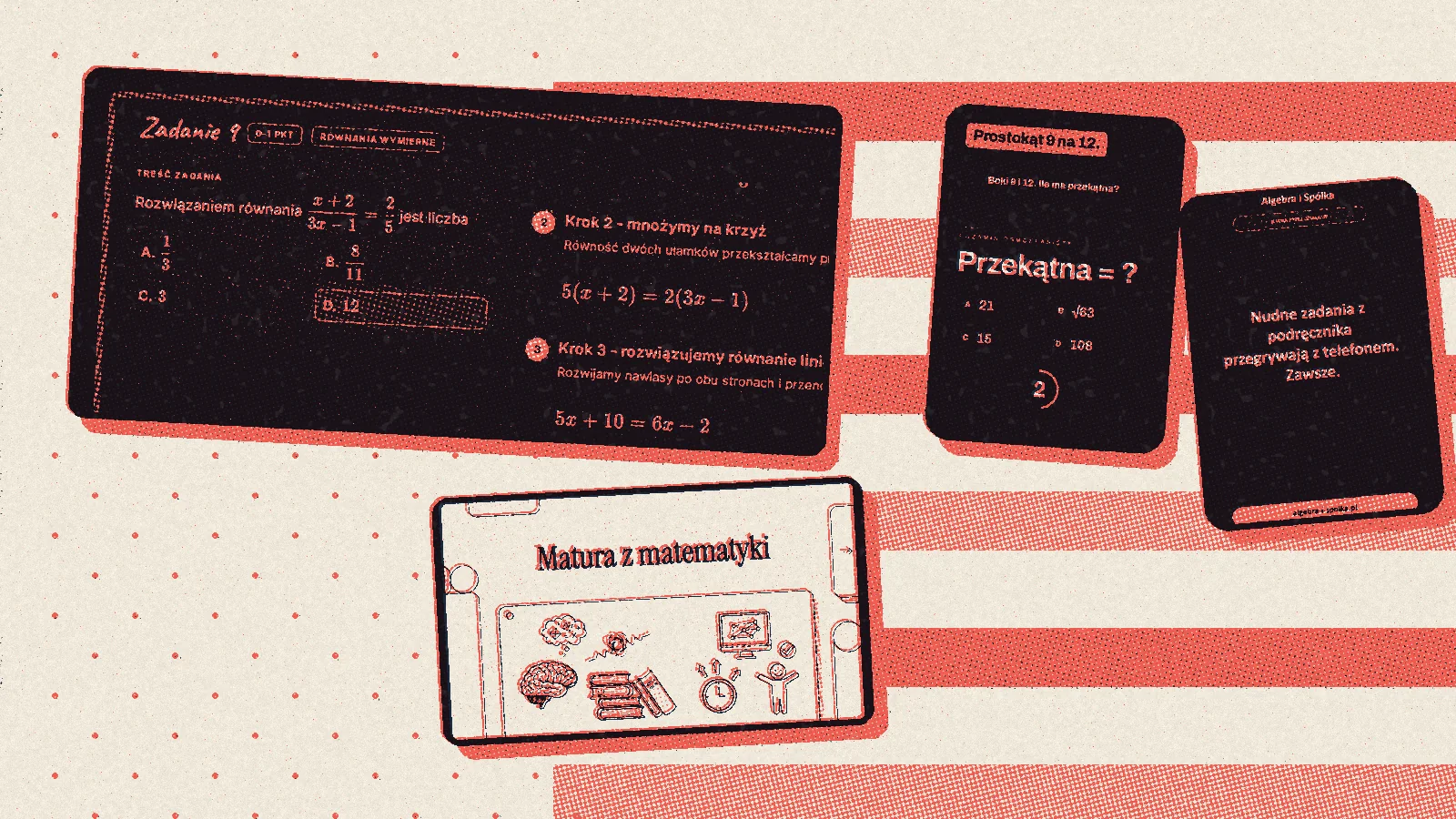
On Algebra i Spółka, solutions to exam tasks write themselves in chalk on a board while a narrator reads them out step by step. I turn the same animations into YouTube videos and short reels for Facebook. It sounds simple, but getting there took me seven months. This post is mostly about what did not work along the way, since there was more of that than of what did.
February: Veo and scripts in advance
The first video on the home page was an ordinary recording uploaded to YouTube. At the end of February I wanted to go further, so I prepared scripts for 95 maths topics. Each topic got three files: a script, a description of the shots for Veo, Google’s generator that makes a video from text alone, and a slide plan for a presentation. I experimented with Veo for a while, but none of those videos ever made it onto the site.
Spring: animation written in code
In April I came at it from the programmer’s side and reached for Manim, a tool in which you create mathematical animations by writing a program. On top of it I built a generator: AI wrote the animation script, Manim turned it into pictures and a computer voice from Google read the text. Two days later came a simpler version without Manim, based on plain slides with charts, and in June I threw both out of the project.
Next it was Remotion’s turn, a tool in which a video is assembled from building blocks, much like a web page. The first animation, with a teacher drawn in the style of South Park, vanished from the videos on the same day it was created, and an ordinary recording went back in its place. The character itself survived, because it grew into the mascot of this site. Remotion did prove useful elsewhere, though: I used it to make ten reels for Panel Biznesu, in Polish and German, and while working on the Panel adverts I tested several computer voices.
July: PowerPoint, Canva and NotebookLM
In July I went back to slides, this time seriously. I laid out the reels as PowerPoint presentations and saved them as video, first by a roundabout route through another office program and later straight from PowerPoint on Windows. I also tried moving them over to Canva.
Around the same time NotebookLM, Google’s tool for working with notes, turned mine into a presentation a few minutes long, with narration. It is quick, but the voice is not mine and there is a daily limit per account. The video version, which is based on Veo, requires the most expensive plan, and you wait half an hour for a single video.
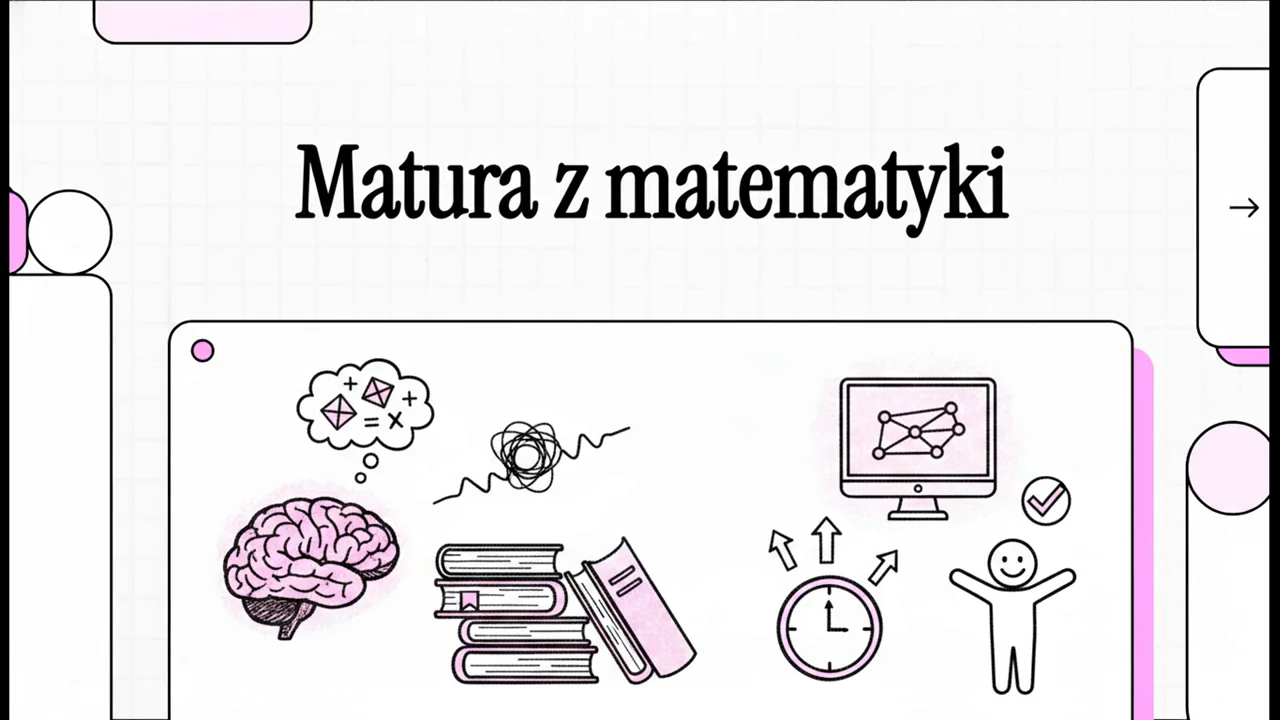
The narrator in those reels was my own voice, cloned on the KikiVoice website. A single text there could be at most two thousand characters long, every recording meant proving I was not a robot, and the finished file disappeared after roughly half an hour. Even so, I recorded one entire exam paper that way by hand, step by step: the additional June 2026 session of the basic Matura, the Polish school-leaving exam.
August: the browser as a camera
The answer came from a completely different direction. At the end of July I made the first exam papers that solve themselves. They are not videos but web pages on which the solution is written in chalk, one character at a time. That gave me the idea I still use today: a scene in a video is just an ordinary web page, and the browser records it frame by frame.
On 1 August I replaced the YouTube video on the home page with seven scenes built like an ordinary web page, which weigh a fraction of what the video did: a few kilobytes rather than tens of megabytes. Two days later I had my own engine, a program that opens a scene like that and saves it as a video file.
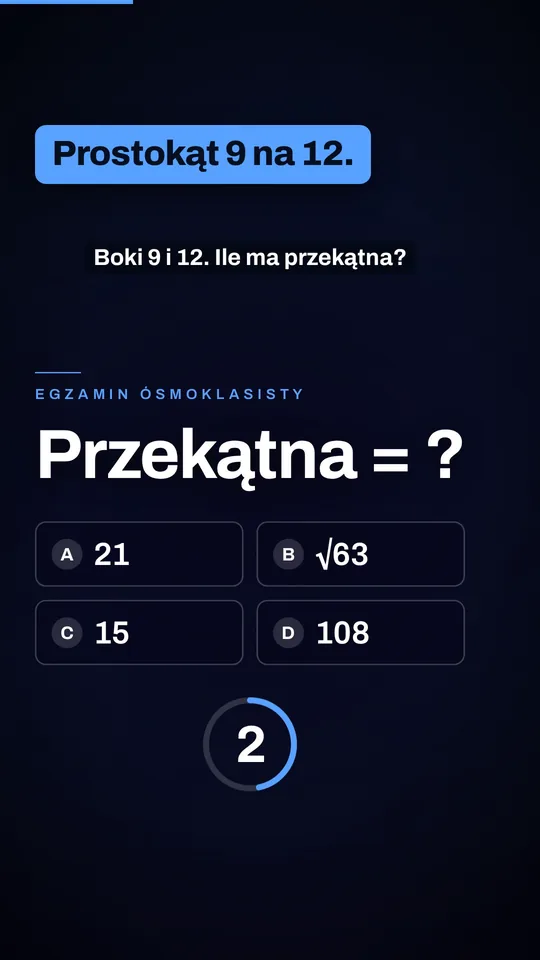
This method has an advantage that all the earlier ones lacked: to fix a video, I fix the text instead of editing everything again from scratch. A reel lasting 22 seconds takes about a minute and a half to produce. A full exam paper, which means 45 to 60 minutes of video, keeps the computer busy for 30 to 40 minutes, with the work split into four parallel tasks.
September: the voice
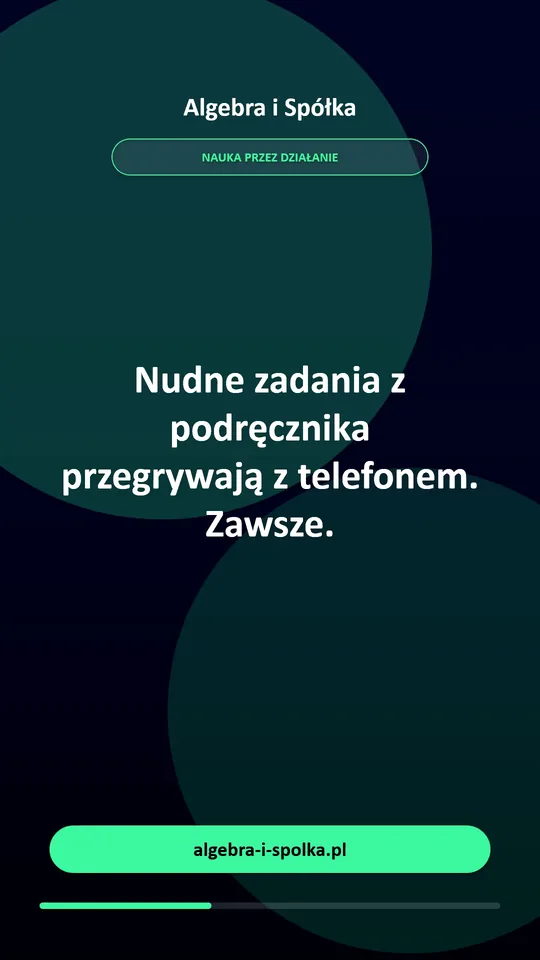
Once the picture was working, the narrator was all that remained, and it took up more of my time than anything else. In mid-September I tried Microsoft’s free computer narrator, which sounded very poor, and Chatterbox, a voice clone running on my own computer, which did even worse. I chose Fish Audio, a service offering computer voices. At the prices I checked at the time, recording the whole task bank would have cost about 130 złoty there and about 520 złoty at ElevenLabs, but in the end I paid nothing, because it turned out Fish Audio offers free test access. To give a sense of scale, the May 2026 paper alone comes to 190 separate recordings and 45 minutes of speech.
The tasks are read by one of the ready-made voices. I wanted it to be my own, but this time cloning turned out to be harder than it looked, because the cloned voice mixed up syllables and sometimes drawled. It was the Polish language itself that got in the way.
Then came the fine-tuning of pronunciation. The narrator stumbled over digits and formulas, so before recording I turn the maths into words, with the proper Polish grammatical endings. It mangled words like “tablica” (board) and “iloczyn” (product), so it got a pronunciation dictionary. Scenes used to cut sentences off halfway, which is why each one now waits for the narrator to finish. Finally, every recording is played to a speech recognition program, which writes it back down as text and compares it with what was supposed to be said.
In the last few days, a problem surfaced that I had missed earlier. In the new reels I heard clipped words and a poor accent, so I took all eleven scheduled posts off Facebook. Measurements confirmed that in nine reels out of eleven a cut fell in the middle of a word, and that speeding the speech up by a quarter spoiled the sound of the voice. Since that fix, a reel goes to Facebook only if it passes an automatic narrator check: normal speed, cuts only in silence and a steady volume. Before the fixes, not a single reel passed. After them, they all do.
What stayed
Three things remain from those seven months, all produced by the same engine: the animated solutions on the site, the videos of exam tasks, and the reels. The video in which I introduce Algebra comes from that engine too. Before choosing a narrator for it, I listened to four. Three tasks from the 2026 Matura can be watched on the Algebra page, and the animated papers open without an account at algebraispolka.pl.