
Games came to Algebra i Spółka for the same reason as the level check, the worksheets and the exam papers. I wanted students to get more from me than an hour’s lesson a week. The first game mode went onto the platform as early as February, together with the student area. Over the summer a handful of loose modes grew into a separate arcade, and in August an adventure game was added. That is the one I spent the most time on, and it takes up most of this post.
The arcade: six games on the same tasks
At algebraispolka.pl/gry there are six modes that open without an account. You first pick a stage, anywhere from grades 1–3 up to the extended Matura, and then one of three difficulty levels: gentle, confident or ambitious.
- Training: ten questions, each followed immediately by its solution.
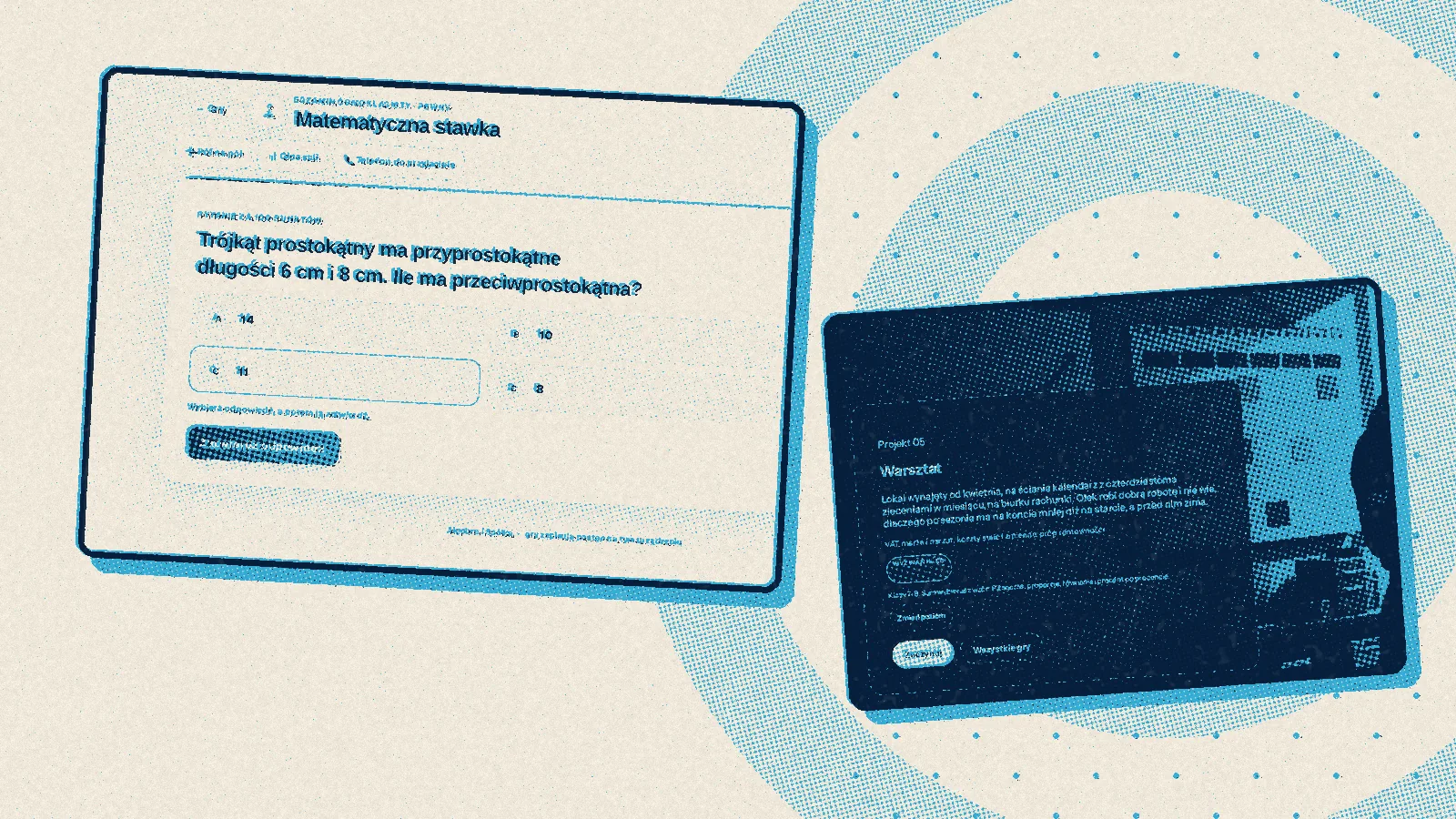
- Maths stakes: a ladder of ten questions, from 100 up to 100,000 points, with three lifelines and two safe levels below which your score can no longer fall. You can take your points and walk away at any moment.
- Balloons: for primary school. You have 45 seconds and three lives to hit the balloon with the right result.
- Matching: six pairs, each made up of a calculation and its result. What counts is how many moves it takes you to join them.
- Sprint 60: one minute to give as many answers as you can, with a streak of correct ones raising the multiplier.
- True or false: twelve statements, and you have to judge each one.
Some of the questions come from a generator, and some from the same task bank the rest of the platform uses. Results stay in the browser, so you can come back to your streak without logging in.
Numbers don’t lie
The adventure game works in a completely different way from the arcade. I made the first prototype, with two cases, on 4 August. A third case followed the next day, and three days after that I rewrote the whole game as a full investigation. The game code alone now runs to more than seventeen thousand lines, and it does not rely on any ready-made game engine, the kind of software games are usually built on.
The game has two series. The first consists of investigations at a single school. The player has no name, and their thoughts in the dialogues are signed simply “You”. Around them is a regular cast: Mr Sikora the caretaker, Marta the captain of the girls’ volleyball team, Olek who fixes bikes, Kajtek, Ms Rejman who runs the technology contest, and Bruno from class 8c. Every case has five stages: the report, examining the scene, questioning, the calculation, and the verdict with an epilogue.
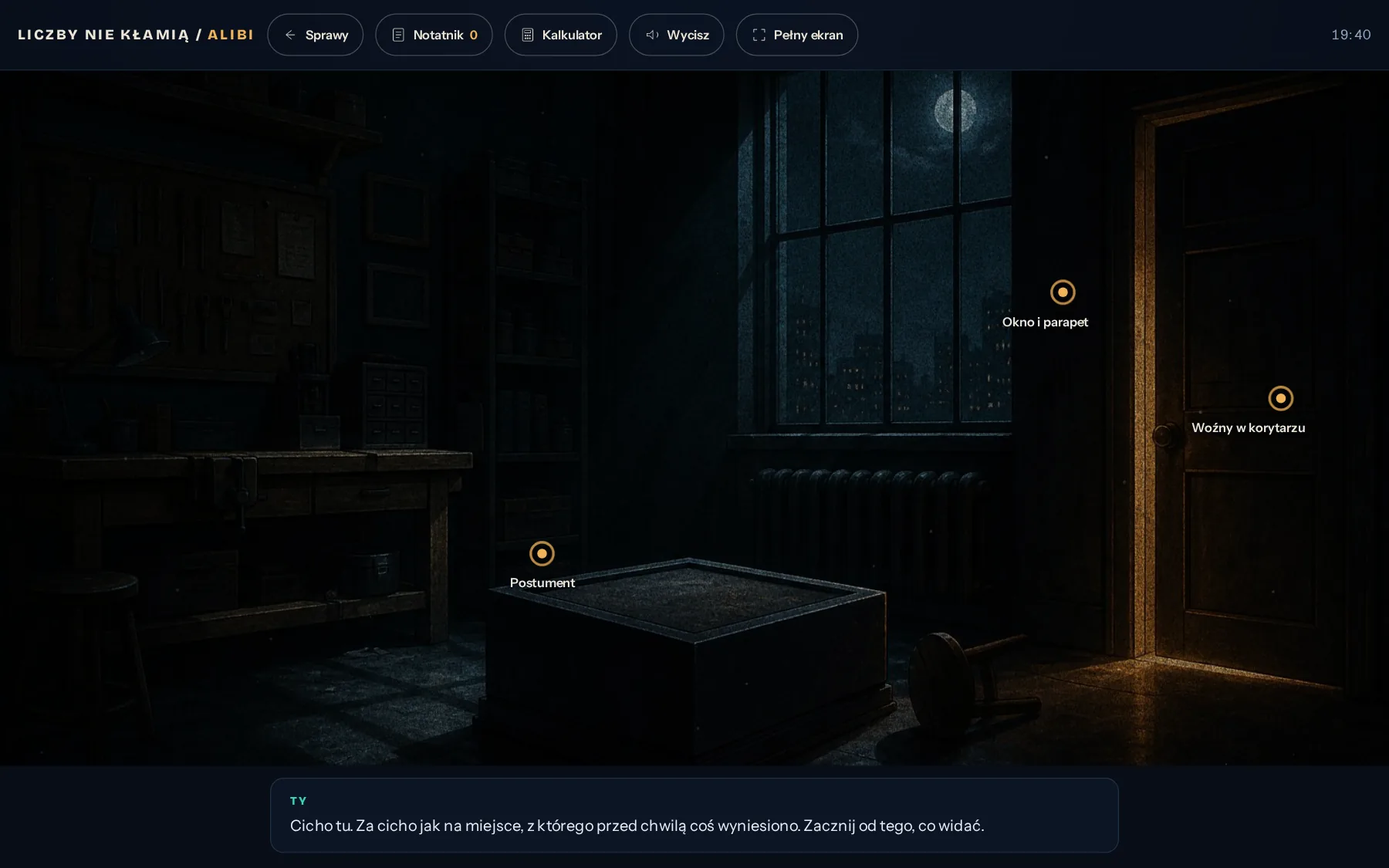
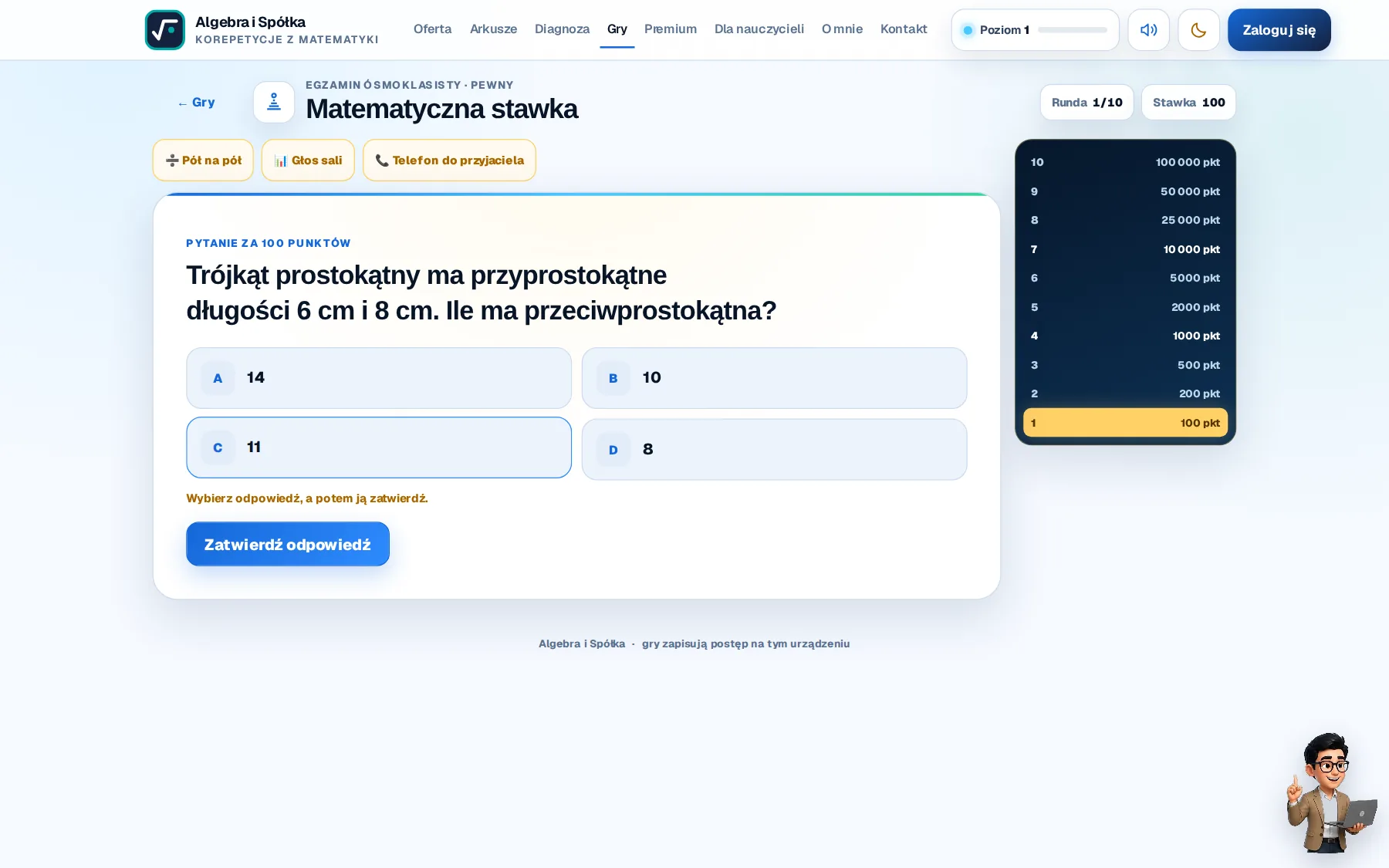
The most important rule of the series is that you cannot name the culprit until you have worked something out. In the first case, a prototype built for a contest disappears from the workshop. Every version of events sounds plausible until somebody runs the numbers. You have to measure a route with a ruler on a 1:25,000 map of the neighbourhood, convert metres per second into kilometres per hour, and reach for Pythagoras’ theorem.
In the second case, 43 złoty is missing from the school tuck shop. There are receipts, discounts and a receipt book, and the player gets a discount slider to check for themselves which version adds up. The third case is pure logic: four people, four time windows and an elimination grid, like the puzzles in newspapers.
There is no penalty for a wrong answer. The game explains what the particular mistake is and lets you try again. There is no clock, no score and no way to lose. A single case takes twenty to thirty minutes.
On your own account
The second series is calmer and closer to everyday life. Across seven projects you build a house, organise a party, plan a trip, go shopping, run a bike workshop, work out energy use and plan a route. Each project consists of six steps, four calculations and two decisions. None of them has one right answer. There is a number the player chooses, and a consequence that follows from it. In the house project, for example, you have to work out how much concrete to order so that it does not run out halfway through the pour and you do not overpay for extra.
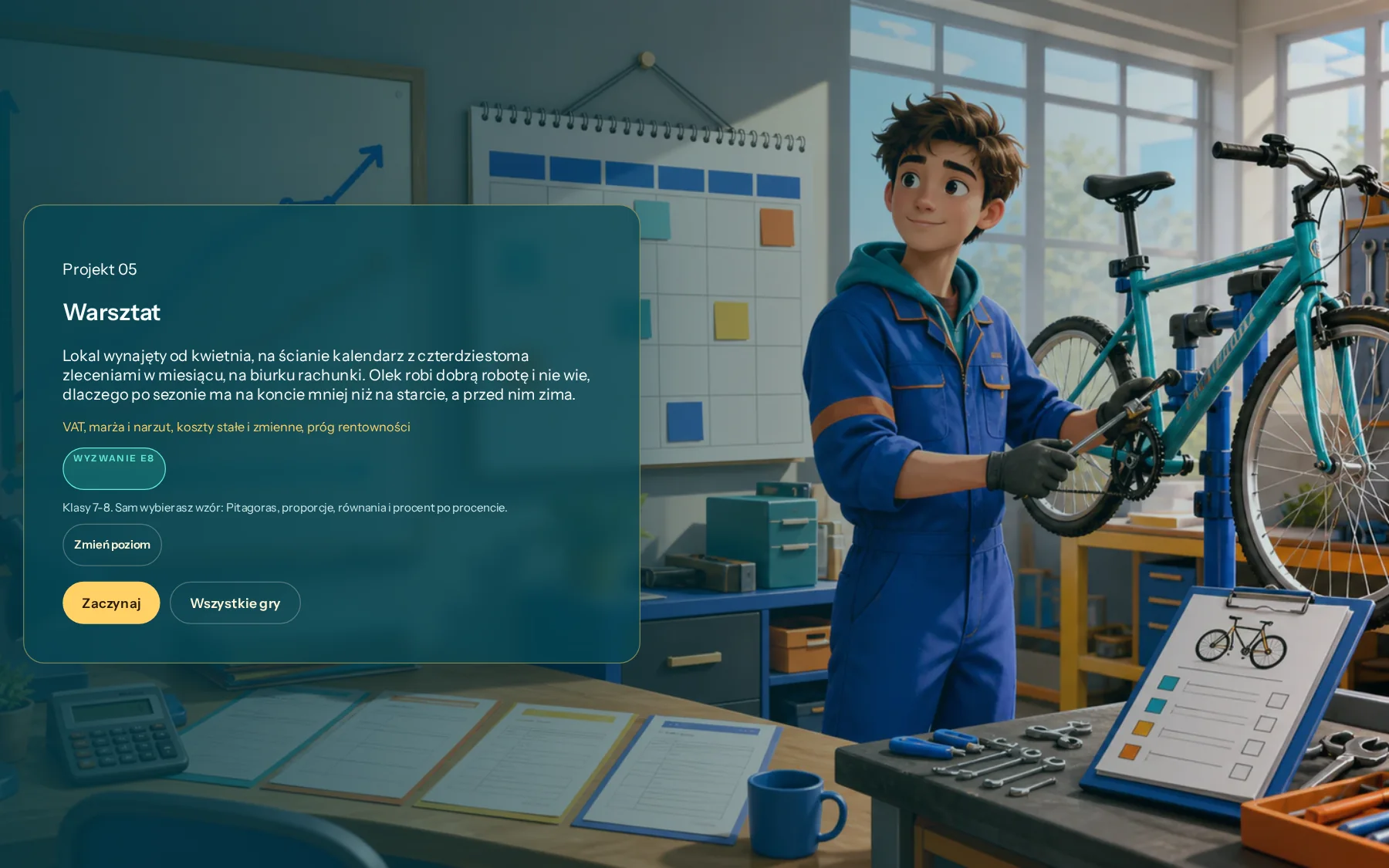
Every project has three levels. Start is for fifth grade and up, and it gives you the dimensions. At the E8 Challenge level, meant for grades seven and eight, the player picks the formula. Liceum+ (secondary school) calls for trigonometry, functions and logarithms. The story stays the same; only the tools change. The projects were created on 17 August, and two days later I reworked them for younger players.
The maths has to add up
In a detective game, a calculation error matters more than in a textbook, because it accuses an innocent character. That is why the game has its own check: before a new version goes live, 278 recalculations test the numbers in the cases and projects. At the beginning of September, while I was reviewing the third case, it turned out that one cell of the grid gave away the solution too early. Because of that, the camera footage that was supposed to decide the case was no longer needed for anything. I fixed it. Since then the check has counted every possible arrangement of the grid, and it holds back the update if only one is ever left again.
The game also has a notebook under the N key and a calculator under the K key, and your progress is saved in the browser. All the games open without an account: algebraispolka.pl/gry (in Polish). Two more cases and a Matura-level season are already written into the script, but I have not built them yet.
This post is part of the story of Algebra i Spółka. I describe the other parts of the platform, the calendar, the lesson whiteboard and the exam papers, in Algebra i Spółka from the inside.