
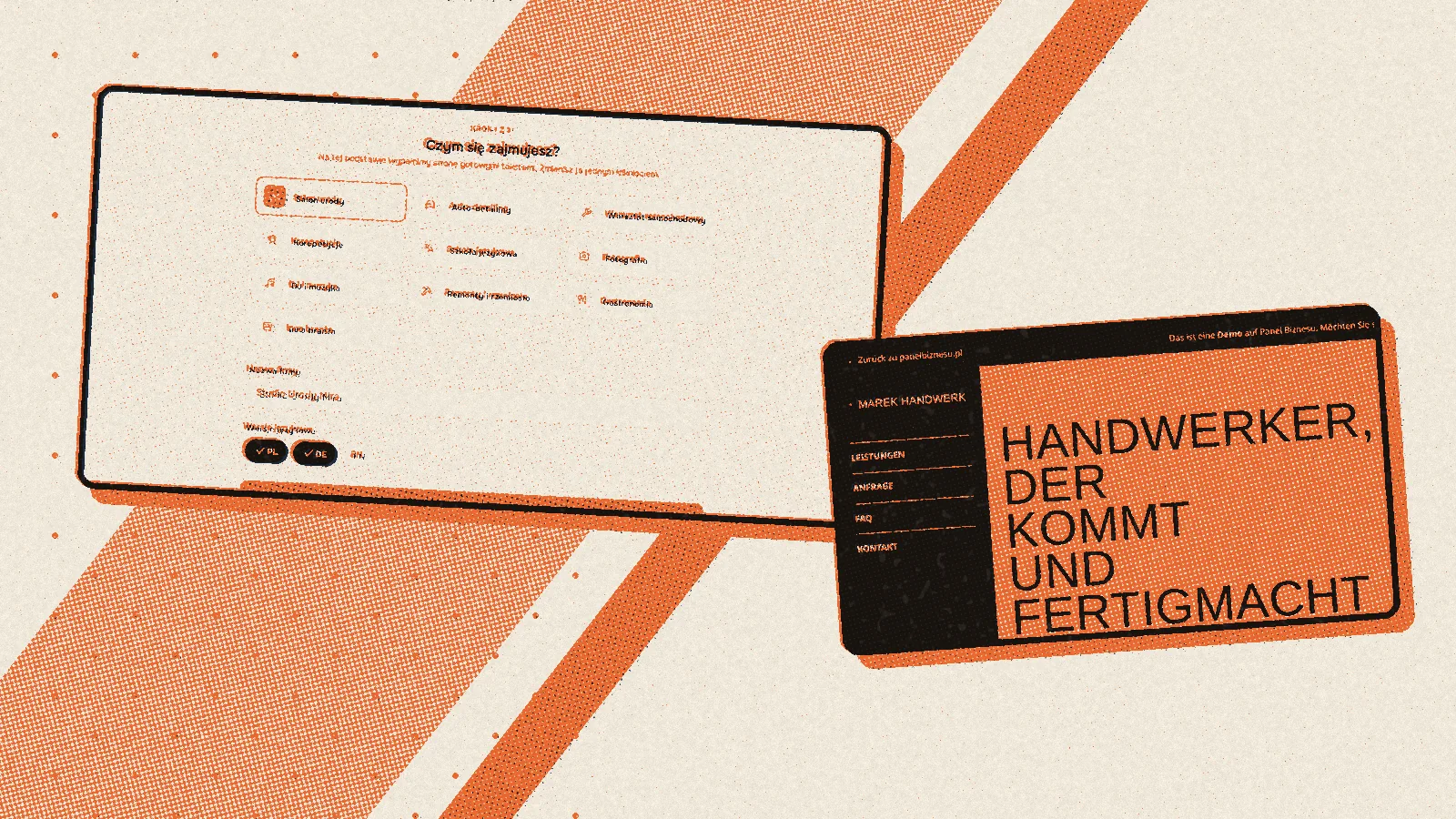
This idea started with something ordinary. I needed a car mechanic and came across a garage that had no website of its own. There was no way to check what exactly it did, how it worked or how to book an appointment other than by phone.
In the end I sorted it out, but that moment stayed with me. If a garage that exists and has customers has no website, how many businesses like that are there around me?
An idea that ran on two tracks
From then on I started paying attention to how small businesses present themselves online. On the one hand I tried to understand the needs and the market: who actually needs a website, what they expect from it, where they look for customers today and whether the service I had in mind could be useful to anyone. On the other hand I had my own experience with Algebra and its calendar, which meant knowing how much work it takes to build something like that from scratch.
For a long time the two tracks ran side by side. Only when I put them together did a concrete idea begin to emerge, though still without a single line of code written just for it.
Everyone is somewhere, just not at home
The longer I looked, the clearer one pattern became. Hairdressers, beauticians and the whole beauty industry are on Booksy or Facebook. Tutors of every kind, from maths to guitar, look for students on Facebook and on classified ad sites. Tradespeople, from plumbers to electricians, collect jobs through Fixly. DJs and photographers show their work on social media, even though they could easily have websites of their own.
Each of these places has its advantages, because it brings in customers who would be hard to find alone. They also share one drawback: the business is only a guest there. Its profile looks like the hundred others next to it, someone else sets the rules, and instead of remembering the name of the salon or the garage, the customer remembers the name of the platform. A photographer with beautiful pictures shows them in the same layout as everyone else. A DJ who has played weddings for years has no place to explain calmly what sets them apart.
The point is not to give up these platforms. The point is to have a website of your own next to them, where the business decides what it shows and how people can book it.
Businesses near the border
I also thought separately about businesses in the border region. I live in Szczecin, so I can see how many salons, garages and practices serve customers from Germany. Before such customers make the trip, they want to read the offer in German and book without a phone call in which they have to fight their way through the language barrier.
A business like that could use a website in two languages and a panel where both languages are managed at once, plus online booking that works the same way for customers from Poland and from Germany. After ten years in Germany it is easy for me to imagine how much good information in their own language means to such a customer before they even pick up the phone.
Me, not so long ago
The most important reason, though, was the closest one. Not so long ago I had no idea how to build a website myself. I wanted a place of my own online and a calendar for my students, and I did not even know where to start, which domain to buy or where it should all run. I got there in the end, but it cost me a lot of time and mistakes, which I describe in the series about Algebra.
There are surely a great many people like that. A mechanic, a hairdresser, a tutor or a photographer would like a website of their own, but they have the same problem I had back then: they do not know how to go about it, and hiring someone to build a site seems expensive and complicated. They need something that shows them a finished website straight away and then lets them edit it themselves, without learning to code.
First steps
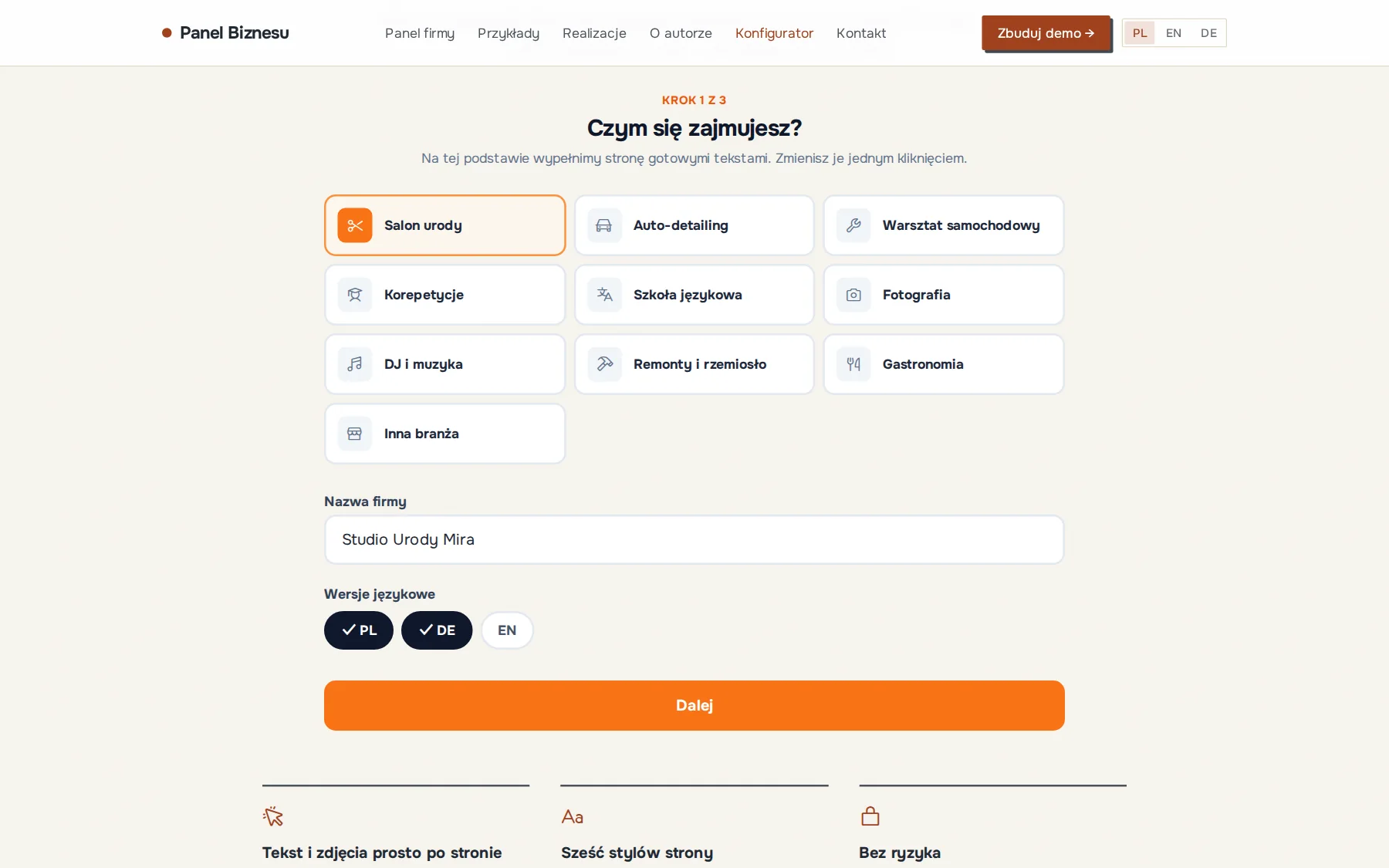
At the beginning of March I made a first attempt, still inside Algebra's code, because that is where I already had a calendar, bookings and a panel. Templates for several industries came out of it, each with its own character: pink and rounded for a beauty salon, orderly for education, and a bolder general one for other businesses. The calendar and bookings I had built for students turned out to be just as useful to a hairdresser or a photographer.
I do not know yet what final shape this idea will take. What I do know is where it started: with a garage that had no website, and with myself back when I did not know where to begin.