
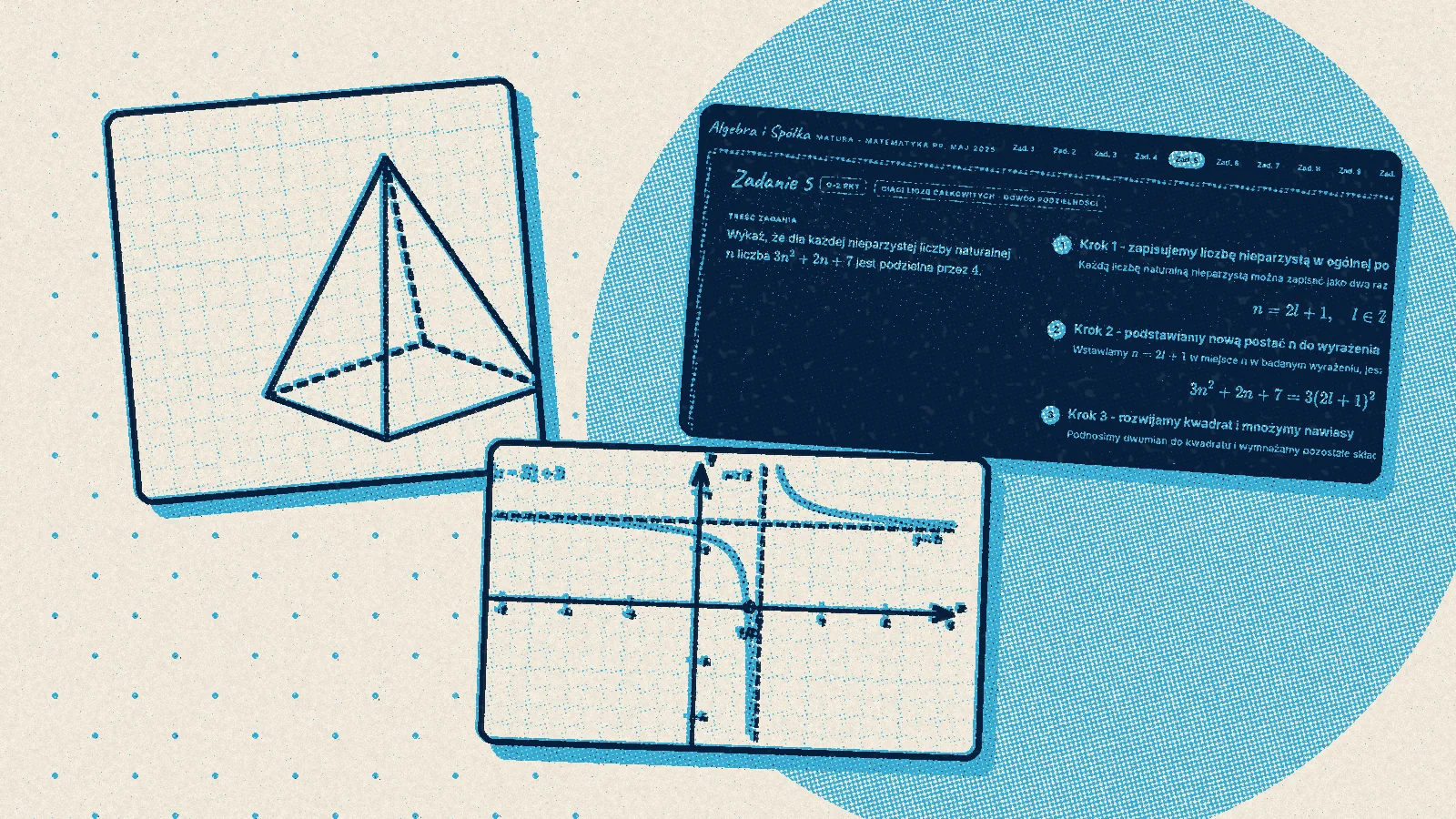
Here I describe Algebra as it is today, one chapter for each part. How I got there, including the mistakes I made along the way, is a separate series: from the first version built with Flask, through bookings that disappeared with every deployment and the move to React, to pricing, Premium and payments. The games grew big enough to get a post of their own.
Lessons without arranging them by phone
I have been tutoring maths for many years. For a long time I did it the way most tutors do: an advert, a phone call, and arranging times over text messages. Two years ago I decided to change that. I wanted a calendar in which students choose a free slot themselves, and a place of my own online that would say more about me than an advert on a listings site.
The ready-made tool that did not exist
I started by looking for something ready-made. What mattered to me was a single calendar for both individual and group lessons. Reservio let you set up one or the other, not both, and it cost money on top of that. WordPress sites with booking plugins were not free either, and I would still have had to bend them to fit my needs.
So I decided to build the site myself and develop it my own way. I had never had anything to do with IT before. I have been building it for more than a year: I learned from zero, made mistakes, fixed them, and went round that loop again and again until everything worked. AI tools helped along the way, but I was the one who had to know what should be built, and to check that it really worked.
More than an hour of lessons
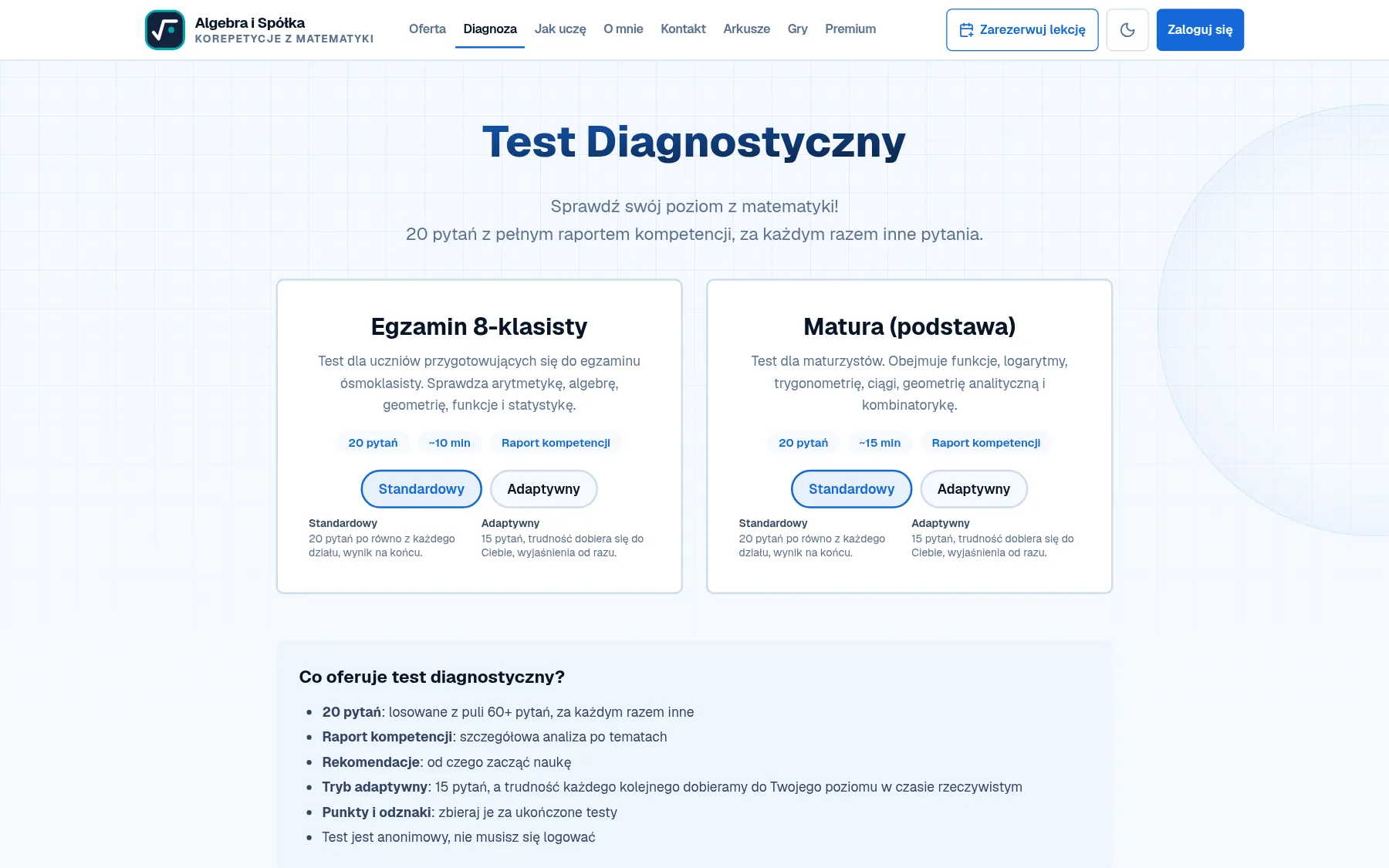
Once the calendar was running, I started adding more. I wanted to give students more than other tutors do, and simply to stand out. That is how a level check came about, then games based on exam questions and an adventure game, worksheets, a lesson room with video and a whiteboard, and later exam papers that solve themselves.
I gave a lot of it away for free. Papers from the CKE (the Polish Central Examination Board) with step-by-step solutions open without an account and without any limit. I want to help people who study on their own and have no money for tutoring as well. I believe good things come back.
And where does the name come from?
I have no good story for this one. I spent a long time thinking about a name and nothing interesting came to mind. In the end I came up with “Algebra i Spółka” (Algebra and Co.) without any deeper thought behind it. I liked it, and it stuck.
The whiteboard that did not exist
For a long time I kept jumping between tools during online lessons. Teams let me make a call, send a message and open a whiteboard, but that whiteboard was no good for maths. Miro had a pretty good whiteboard, only everything else had to happen somewhere else. There was nowhere I could have it all at once.
What I was missing
The thing that annoyed me most was a small one. In Miro the toolbar sits on the left, and since I am left-handed, I kept catching it with my hand. The more serious problem, though, was what a maths lesson needed and did not get:
- 3D solids, function graphs and a proper coordinate system,
- a way to type formulas so that they look like formulas and not like text full of slashes,
- a dark theme for evening lessons,
- joining without registering, because many students struggled even to get onto the whiteboard from a link or an email,
- the option to embed the whiteboard on my own website and keep developing it.
I wrote about this on LinkedIn when I showed the first version. The conclusion was simple: if a tool like that does not exist, it has to be built.
What came of it
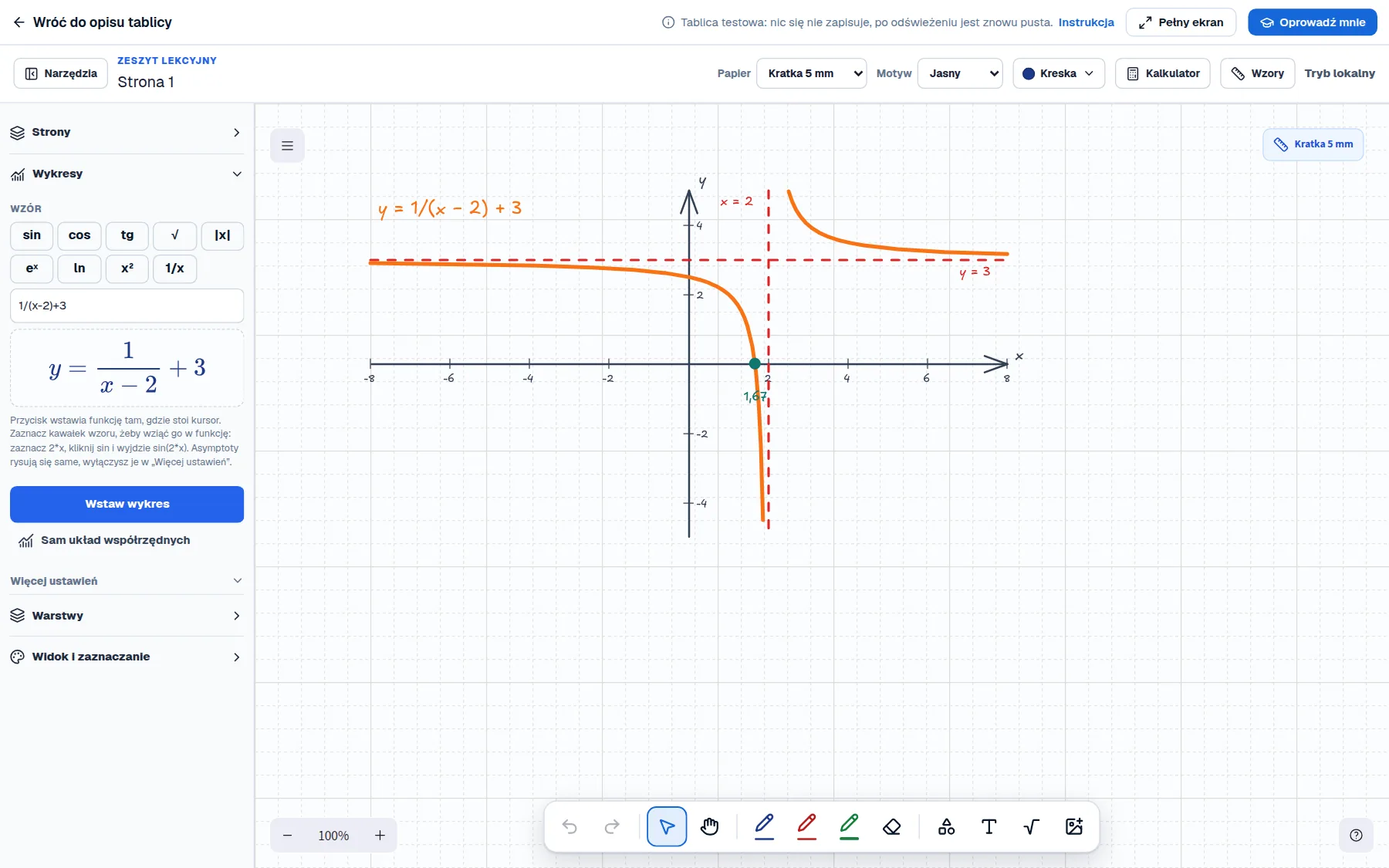
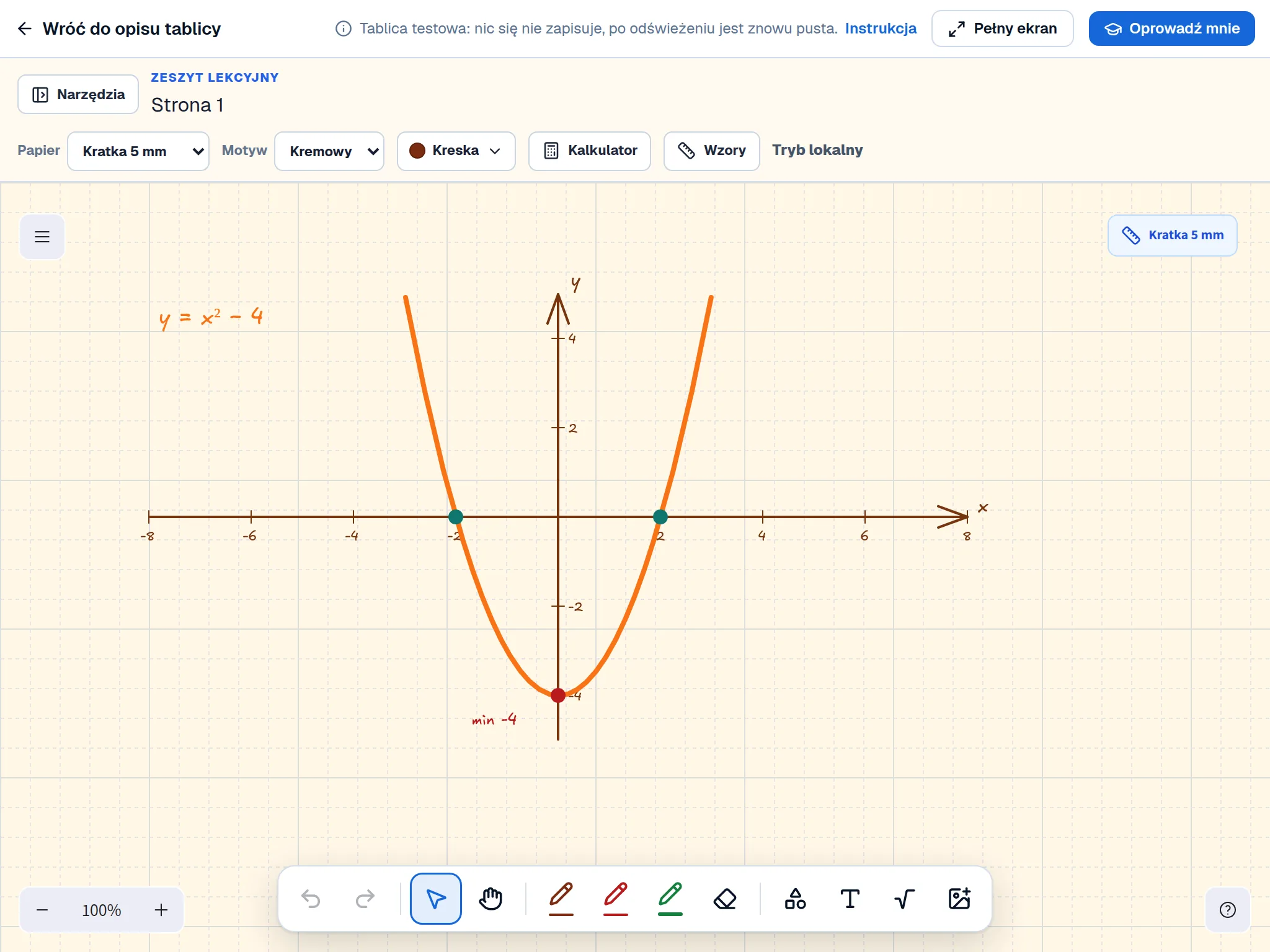
Today a student clicks a link and is straight into the lesson, with no account and nothing to install. I type in a function, say 1/(x−2)+3, and the whiteboard draws the graph, marking the asymptotes, zeros and extrema on its own. 3D solids show their hidden edges as dashed lines. Formulas are typed on the keyboard, and you see right away how they will look. The call and the camera run in the same browser tab, and I moved the toolbar to the bottom, so my left hand no longer catches it.
I have been giving my own lessons on this whiteboard for months. When other tutors started asking whether they could use it, I split it off from Algebra i Spółka as a separate product. First, though, I checked whether it could cope with a whole class. With thirty people on one whiteboard, the teacher’s strokes reach the students in a fraction of a second, and not one of them gets lost.
You can try the whiteboard without creating an account: whiteboard demo. I write more about what it can do on its page.
Exam papers that solve themselves
Tutoring has one hard limit: a day only has so many hours. Every lesson is an hour of my life exchanged for money, and I cannot sell it a second time. At some point I began to wonder how I could make a product rather than only selling my time.
Why exam papers
A Matura paper (the Polish school-leaving exam) with a step-by-step solution takes care of several things at once. It works as an advert, because it shows how I explain things before anyone books a lesson. It helps people who study on their own, since it is free and needs no account. And it works without me: the same paper can be opened by one person or by a thousand.
This is how it looks. A student opens a CKE paper in the browser and works through the tasks. When they do not know how to begin, they reveal the solution, which appears on a green board as if someone were writing it in chalk, while a narrator reads out each step separately. Under every step there is an “I don't understand this step” button, so there is no need to watch the whole task from the beginning. I have worked through 106 papers this way so far: basic and extended Matura papers as well as the Polish eighth-grade exams. That comes to 2750 tasks in total.
The hardest task I have set myself
It was genuinely hard, and it taught me a great deal. The solutions are written with the help of AI, and that is exactly why I do not take them on trust. I calculate every result in two separate programs, SymPy and Wolfram, and then compare it with the CKE marking key. The geometry drawings are generated from code, so if a point is supposed to lie on a circle, it really does. The narrator struggled with digits and formulas. So before recording, I turn the maths into words with the correct Polish endings, and I check the finished recordings by transcribing them back into text.
Each paper is stored in several places at once. Even so, after a few failed updates to the site some of them vanished, so since then an automatic check has run every five minutes to make sure they are all in place, and if they are not, it restores the previous version of the site by itself.
The papers are free and need no account: list of papers. How many attempts it took me to arrive at videos with a narrator is described in a separate post.
Games based on exam questions
Exam questions also power the games: an arcade of six quick modes and the adventure game “Liczby nie kłamią” (Numbers don’t lie), in which you can only name the culprit after doing the maths. Their story, the characters and how I check the numbers in each case are in a separate post, and you can play without an account at algebraispolka.pl/gry (in Polish).
All these parts now run side by side, and the papers, the games and the whiteboard demo all open without an account. You can see the platform here: algebraispolka.pl. I write more about what is on it on the project page.