
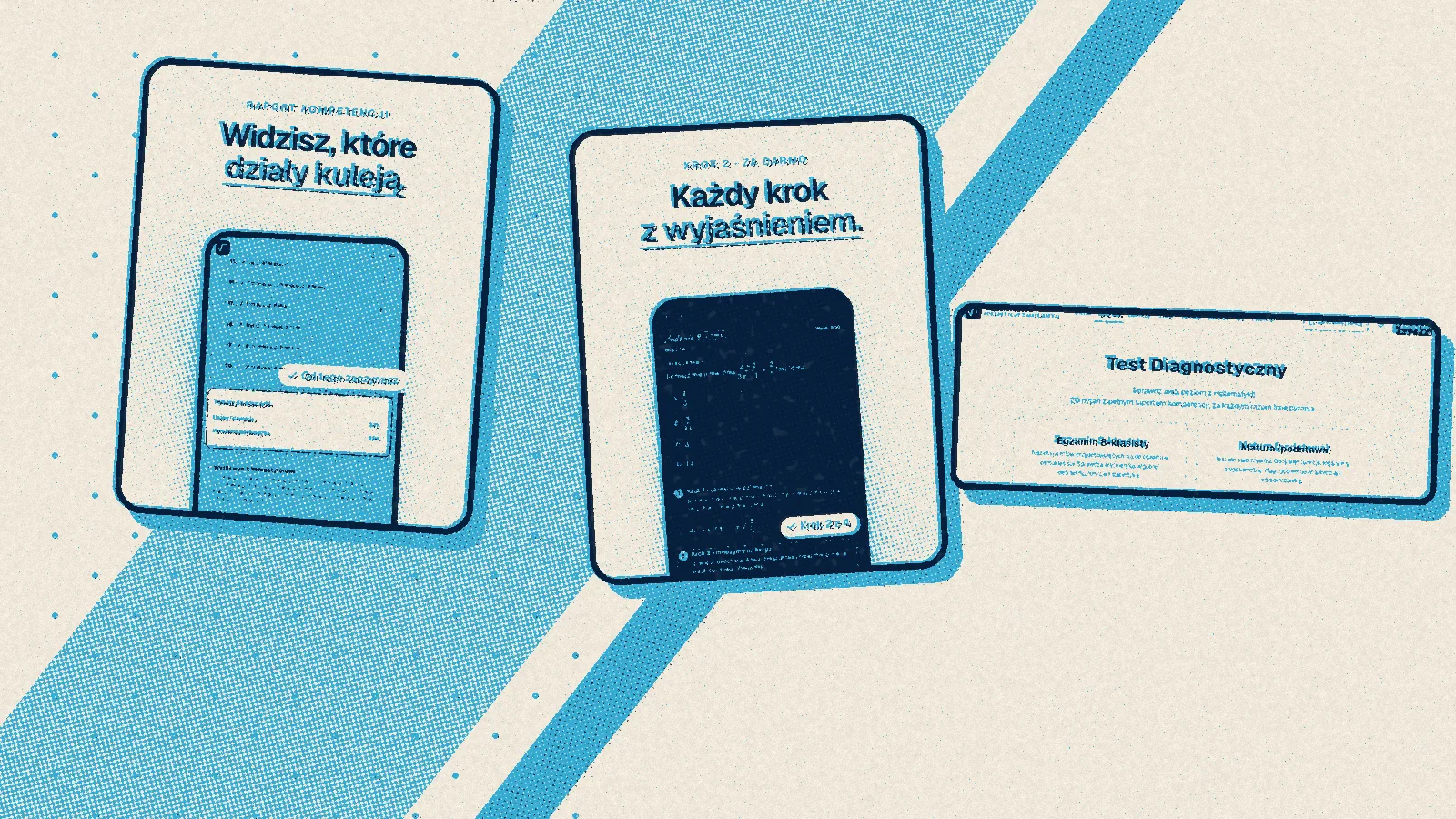
At the beginning of October I changed direction. Until then, Algebra was above all a place for booking lessons with me, while the exam papers, games and whiteboard stood next to them as extras. Now it is meant to be the other way round: the platform should prepare a student for the Polish eighth-grade exam or the basic-level school-leaving exam on its own, including a student who can't learn from a textbook or from videos, and a lesson with me should be something special rather than the only way to get going. It sounds good on paper, except that each of these changes opened a front of its own.
A platform that teaches, not just checks
Premium costs 39.99 zł for 30 days or 249 zł for a year. The diagnostic test, all exam papers, the games, the theory for each topic and five checked tasks a day stay free, while Premium adds a study plan built from the diagnosis, a test after every topic, reviews of mistakes after one, three and seven days, unlimited mock exams and a Sunday email for parents. Lessons with me are not part of the subscription, not even the yearly one, because a single lesson costs roughly half of the yearly plan.
So the key question is: does the platform really teach? A review I did on 5 October gave an uncomfortable answer, because it turned out that Algebra checks very well but explains little. Multi-point tasks and proofs, which make up roughly 45 percent of the score in the school-leaving exam, were almost missing from the learning path, and the task bank consisted overwhelmingly of one-point tasks. Over the following days came lessons for 170 topics, 81 tasks broken down into stages, 14 of them proofs, and a "Why is my answer wrong?" button that shows where the reasoning went off track. Every lesson goes through an automatic check of its calculations before it reaches the site.
Whether that is enough for a student to pass on their own, I don't know yet. My tests won't settle it; the first students to complete the whole path will.
App stores, or doors you pay for
The app runs on my iPhone and iPad (I described how it got there in the previous post), but a stranger can't install it yet. A developer account in Google Play costs 25 dollars once, and a new personal account has to pass a closed test before publishing anything: at least twelve testers for fourteen days. Finding twelve people who will genuinely open a maths learning app for two weeks is harder than it sounds, which is why every tester will get a Premium code from me.
Apple charges 99 dollars a year and sets its own conditions. Since you can sign in to the app with Google, it must also offer Sign in with Apple, and every version is reviewed before it reaches the App Store. Then there are the payment rules: Premium gift codes can only be redeemed on the website, and the app may not even mention that Premium can be bought elsewhere. On top of that I still need to talk to my accountant about how to book sales through the stores, because that is a completely different case from a BLIK payment on my own website.
Reels someone will actually watch
The most trial and error lies behind me with reels. I wrote separately about seven months of looking for a way to make videos, but a lot has changed since then. The computer voice-over I spent all of September on turned out to be simply tiring to listen to, so on 3 October I removed it from the reels and kept captions with music. The daily quizzes didn't hold up either, because people were far keener to watch a plain recording of me solving a task at the whiteboard. A quiz now goes out at most once a week.
Today I made reels in a completely new style. The starting point was someone else's reel that I wanted to match in spirit: pretty, eye-catching and dynamic. The first version looked good but didn't fit Algebra, so the second combines the look of the website, with the same typefaces, navy and light blue, with a real recording of the platform on a phone. Above the recording things move: large numbers for each step, camera zooms, highlighted buttons and cuts on the beat of the music. Five versions differ only in the track, the music plays more quietly than in earlier reels so it doesn't grate, and I'm choosing which one goes out.
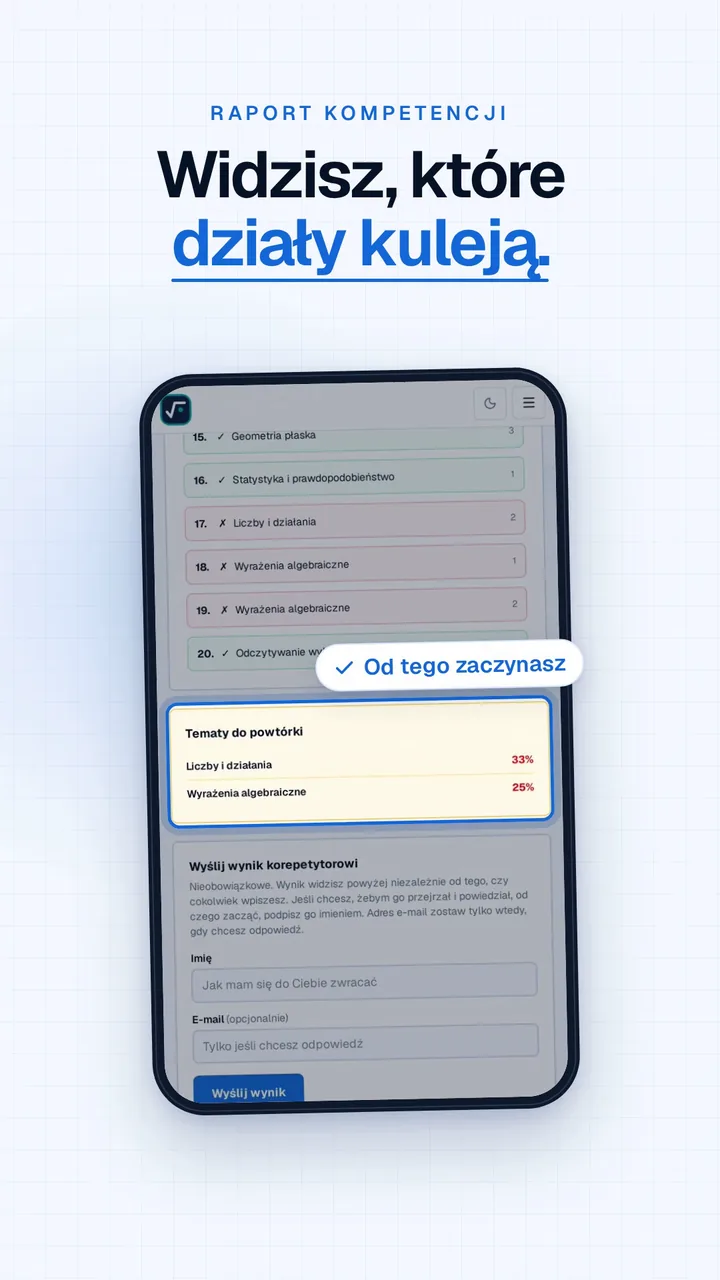
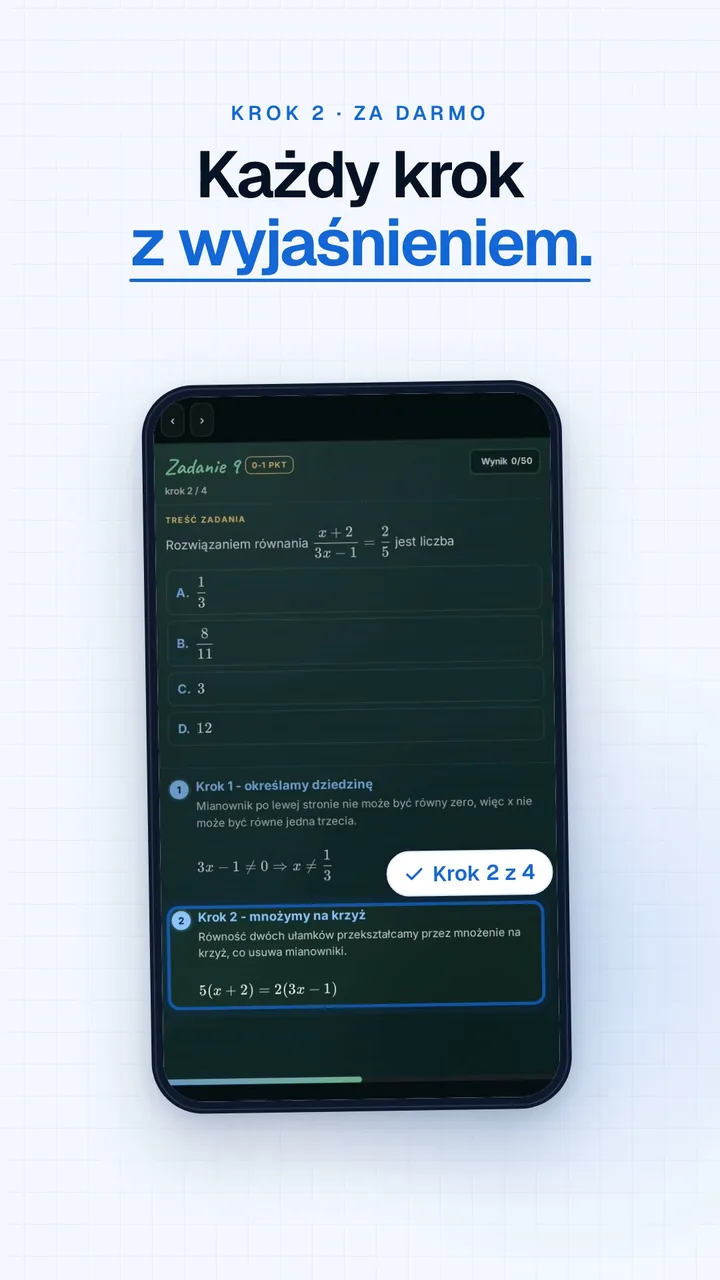
Alongside them, twelve pieces about Premium, six reels and six carousels, are waiting to go out on Facebook and Instagram from tomorrow until 22 October, almost every day at the same time.
Trust you can't program
The hardest part is something I can't build in any code. The students I work with speak well of the lessons, but they say it to me, and I have no written reviews that a parent who doesn't know me could read before the first meeting. I set up Algebra's Instagram profile on 3 October, and on Facebook I'm also only collecting the first followers. On top of that, Szczecin has a great many ads for maths tutoring, and most of them are clearly cheaper than my 120 zł an hour. I don't intend to lower my price, even packages don't drop below a hundred złoty an hour, so I have to show the difference through what a student gets between lessons. The trouble is that I have to show it to someone who is seeing me for the first time.
Two weeks
I gave myself two weeks, until 20 October, to get the website and the app into shape. The review from 6 October split Algebra into six areas: the website, self-study, mathematical correctness, papers with the whiteboard, games, and the brand together with the app. Scores ranged from 6.5 to 7.5 out of 10, and the app's readiness for the stores got a 5. Most of the remarks have already been fixed and released, and after 20 October I'll run another review to see whether the numbers have moved.
All of this happens after hours, alongside my work on fibre-optic projects, so I have to spend every evening on what a parent or student will see, not on polish that only I would appreciate. Whether the new reels, Premium and the app will reach people, only the coming weeks will tell, and not through my tests but through the numbers from the profiles and the stores.