
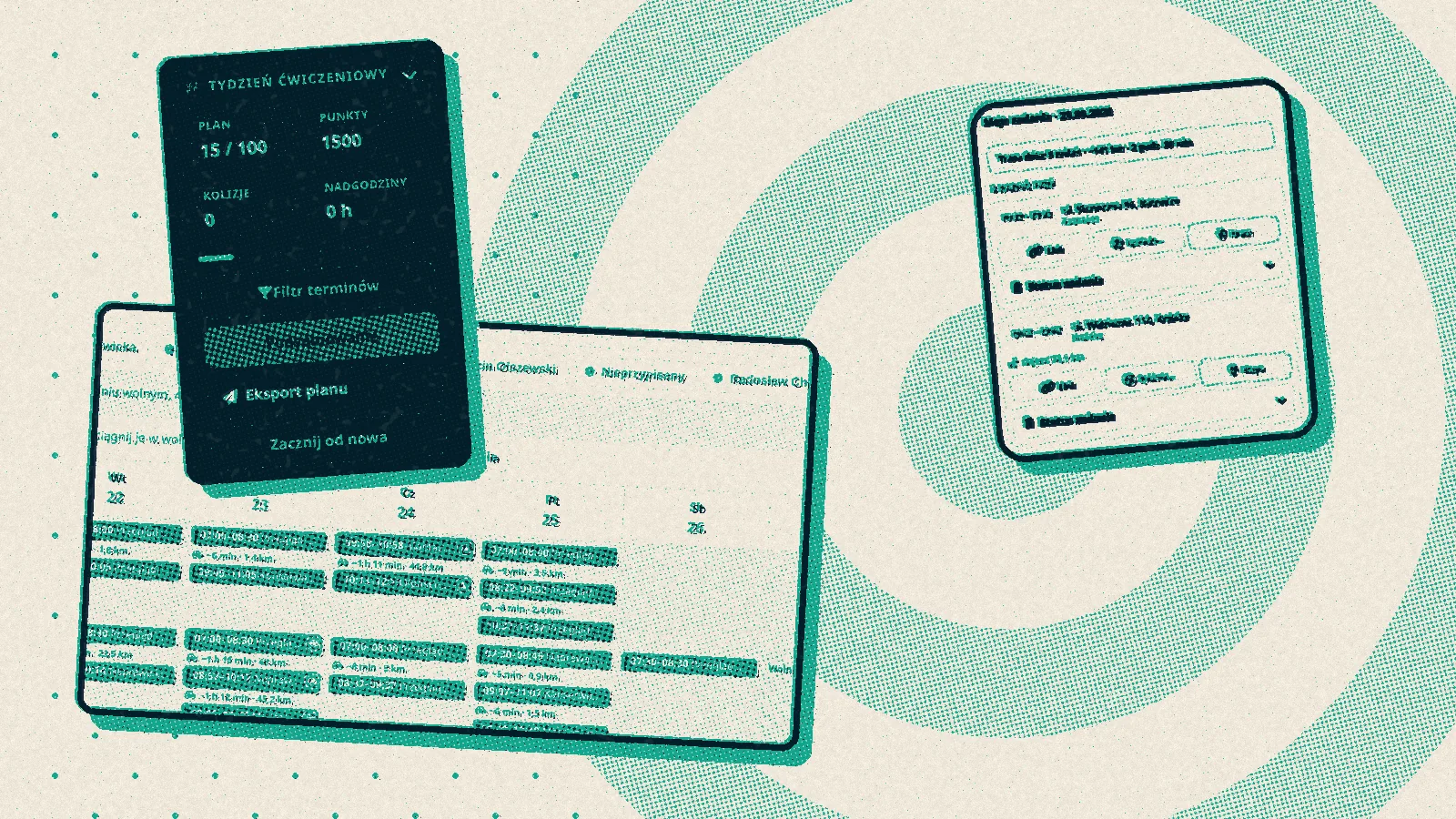
For years in Germany I drew up schedules: shifts at staffing agencies, crews on production lines, transport. Those years left me with one firm belief, which is that planning cannot be learned from a lecture. A plan looks fine until the first call from a client who, as it happens, cannot make it on Thursday.
How Planer Operacyjny itself came about is told in a separate post. Student mode is a much more recent thing and, to be honest, not my idea. I was talking about the project with my fiancée, and she, as a researcher, immediately saw more in it than a program for companies: a ready-made lab, for logistics students for example, where you get the same tools a dispatcher works with, together with a real problem to solve.
An exercise as a starting point for research
Her idea went beyond using the program in class. Two groups could receive the same task: one would schedule the calendars independently, while the other could use an AI assistant. The comparison would cover both decision quality and mental workload. The study and its findings could later form the basis of a research paper or an engineering thesis.
My part is to prepare a tool that records the plan, the exercise score and the course of the work. Measuring mental workload needs a separate method, and group assignment and comparison conditions need to be settled before the study begins. The score describes performance under the program’s rules; conclusions about decision quality and the role of AI would require analysis of the collected data. For now, this is a research idea, not a report of findings.
Two labs
The student gets a single week, Monday to Friday, with no specific dates. There are two labs:
- Physiotherapy. Six physiotherapists in the West Pomeranian region, a hundred home visits, eight working hours a day.
- Logistics. Six drivers across Poland and ninety trips. The exercise uses a daily driving limit of nine hours.
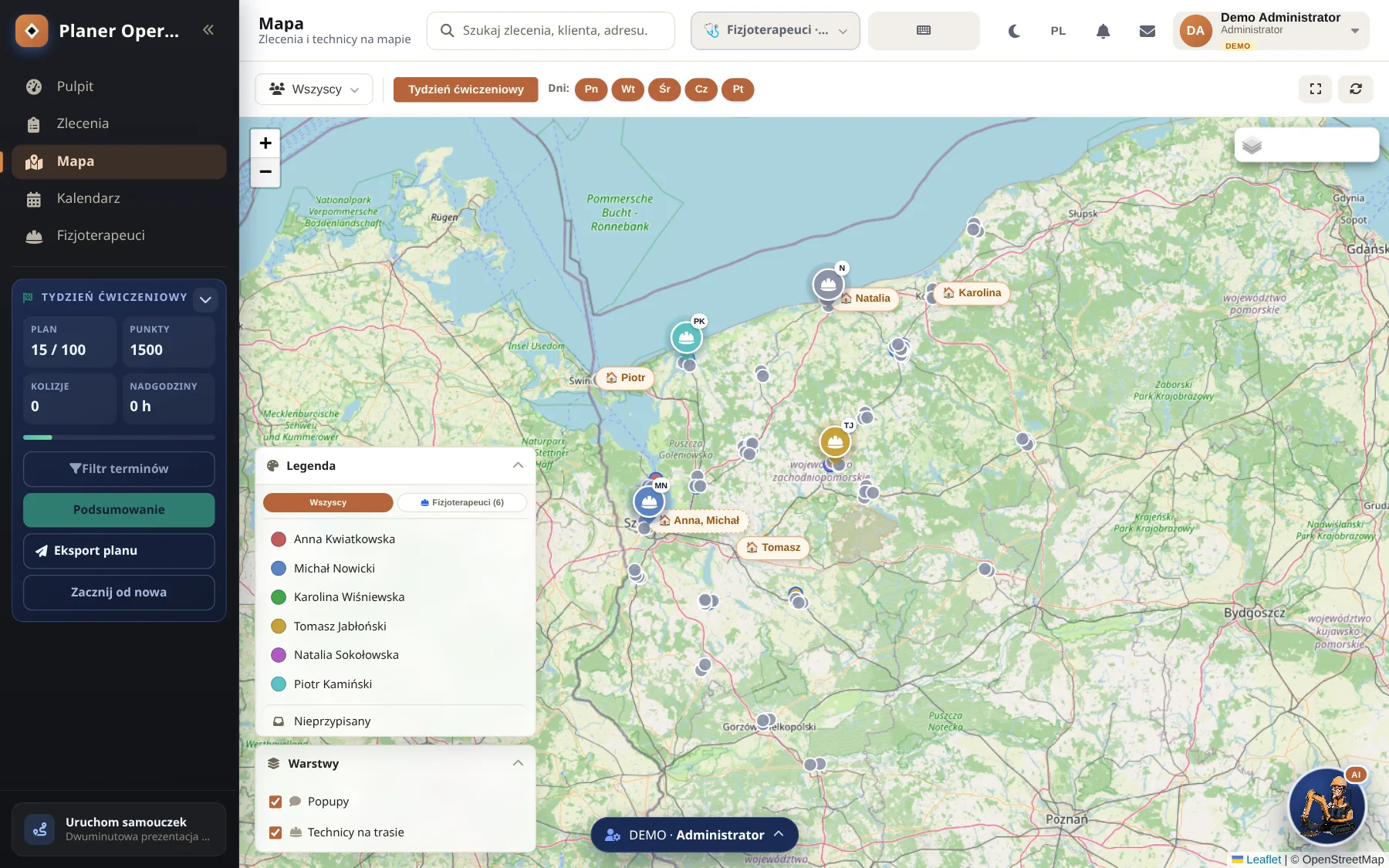
Some towns lie between the bases, and there is no obvious answer to who should go there. Twenty visits are already booked: fifteen with specific people, while five are waiting in the “Unassigned” tray. That is what a Monday looks like in a real company.
The client does not say straight away when they are free
The whole exercise rests on this. A job comes with nothing more than a note such as “ideally before noon”. The student learns the exact hours only after clicking “Call” or “Send an email” and talking to a simulated client. Every client has at least two time windows and will accept only a slot that fits entirely inside one of them.
I wanted the student to feel that information has a price. They can call everyone at the start and plan on certainties. Or they can plan by eye and hope for the best. Either approach is allowed; the result will just be different.
Points
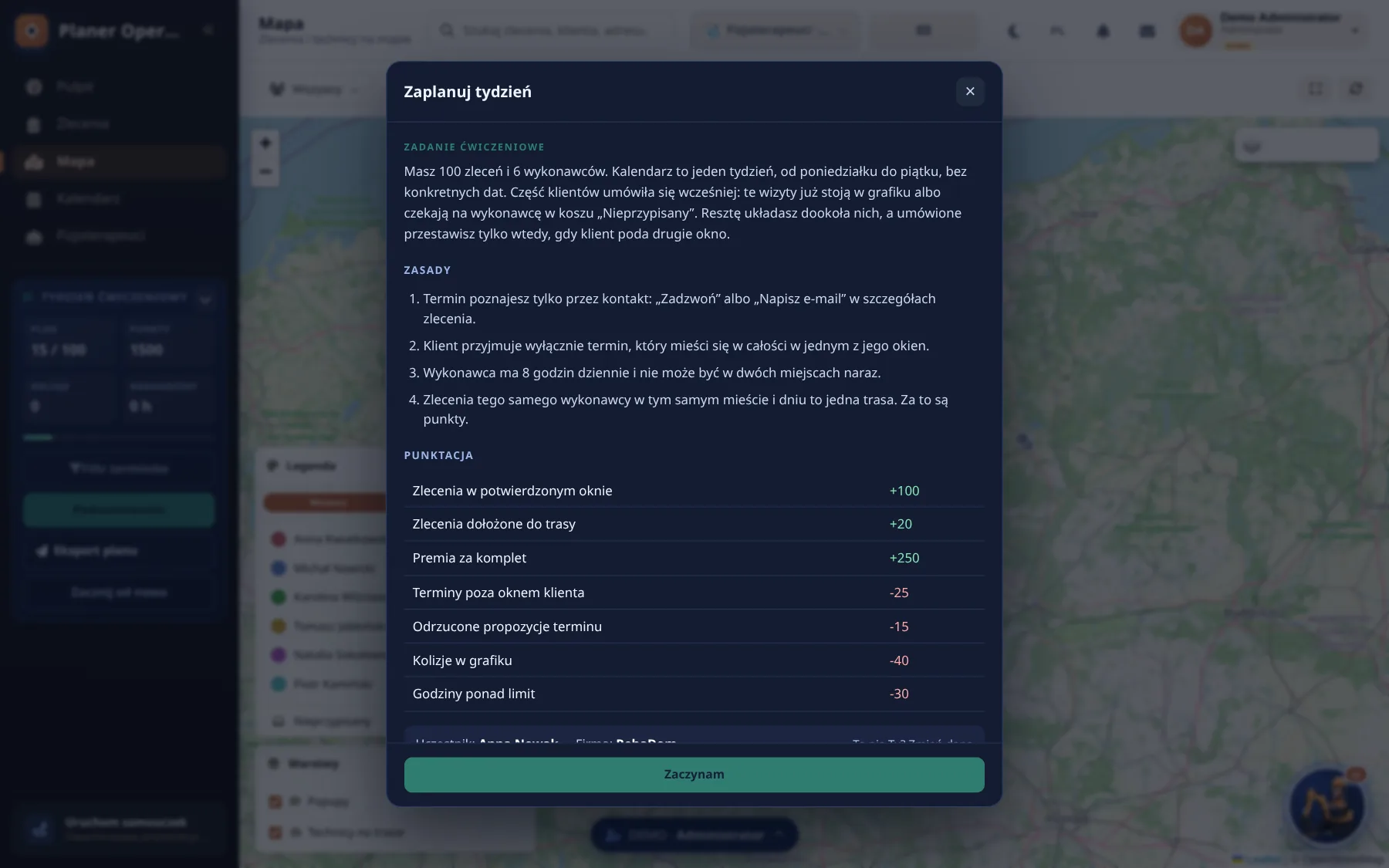
The points are counted automatically, so two people with the same plan will always get the same number of them.
| What happens | Points |
|---|---|
| A visit in a window the client confirmed | +100 |
| A visit added to a route that goes to that place that day anyway | +20 |
| Full set: everything planned, no clashes and no overtime | +250 |
| A slot outside the client’s window | −25 |
| A proposal the client turned down | −15 |
| A clash in the schedule | −40 |
| Each started hour over the limit | −30 |
I deliberately leave the bonus for adding a visit to an existing route out of the maximum. A good plan can therefore collect more than the task requires, but the score still stops at one hundred per cent. I did not want students chasing the bonus at the expense of visits inside the clients’ windows.
At the end the student is given a rank. Below 40% they are a trainee, from 40% a dispatcher, from 65% a planner, and from 85% a route master.
For the instructor
The student does not create an account. They enter the class password from the instructor along with their first and last name, and they can begin. The plan is saved in their browser. What reaches the server is the result with an event log, and the plan itself only once the student sends it to the instructor. In their own panel the instructor sees a table with the whole group’s results, which they can export, adding a grade and a comment for each student.
At the start, the student chooses a research group: with the AI assistant or without it. The log then records how many times someone asked the assistant and how long the questions were, but not what they said. The results of the two groups can then be compared without looking over anyone’s shoulder.
The German version offers a choice between a map of Poland and a map of Germany. On the German map, physiotherapy takes place in Berlin and Brandenburg, and logistics has its bases in six large cities.
What next
The exercise works and can be run in class with nothing to install. Do you teach logistics, production management or work organisation and would like to try it with your group, or are you looking for a topic for a study or a thesis? Write to me. A description for instructors is on the Planer website.